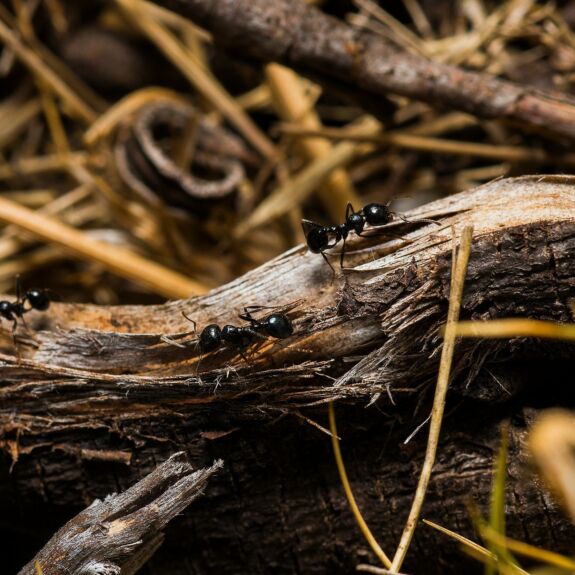
With the return of warm weather also comes the return of insects in the home (unfortunately, there’s no escaping it). Among the most common unwelcome guests are ants. But beware: not all ants are as harmless as they seem. Some are content to steal a few crumbs, while others can seriously damage your home.
A common confusion exists between the small black ant, often harmless but annoying, and the dreaded carpenter ant, which is capable of causing major structural damage. While one is simply searching for food in your pantry, the other may be quietly compromising the integrity of your home’s wooden structure.
Knowing how to tell them apart is the first crucial step in protecting your real estate investment. In this article, we help you identify these two species and understand the risks associated with each.
What is a carpenter ant?
The carpenter ant (Camponotus) is one of the largest ant species found in North America. Contrary to popular belief and unlike termites they do not eat wood. Instead, they excavate it to build their nests, creating complex tunnel systems that can weaken the wooden structures of your home.
These ants prefer moist or decaying wood, but once a colony is established, they can also attack sound wood. A mature colony can contain several thousand individuals, and when they settle inside walls, the damage can remain hidden for a long time.
The common black Ant: A household nuisance
The common black garden ant or pavement ant is usually the one you see marching in a line across your kitchen counter. While they can contaminate food, they cause no physical damage to the home. They typically nest outdoors under patio stones or in soil and enter homes mainly in search of sweet or greasy foods.
How to identify carpenter ants
Visual identification is essential to assess how urgent the situation is. Here are the key characteristics of carpenter ants:
- Size: Carpenter ant workers are noticeably larger, typically measuring 6 to 13 mm (¼ to ½ inch), while queens can reach up to 25 mm. Common black ants are much smaller and rarely exceed 4 to 5 mm.
- Thorax shape: This is the most reliable indicator. Viewed from the side, the thorax (the middle section of the body) of a carpenter ant is smoothly rounded and evenly curved. The thorax of a black ant appears uneven or humped.
- Head: Carpenter ants have a large, heart-shaped head with powerful mandibles used to excavate wood.
- Color: Although often black, some carpenter ant species can be reddish or dark brown.
Life cycle and nesting habits
Like other social insects, ants live in highly organized colonies. In spring, winged ants (reproductive ants) may be seen swarming to establish new colonies.
- Carpenter ant nesting: Carpenter ants often establish a main nest outdoors (in a tree stump or dead tree) and satellite nests inside homes, where they find warmth and moisture. These satellite nests do not require a queen to cause damage.
- Black ant nesting: Black ants almost always nest in the soil. If you see them indoors, they are usually traveling back and forth between the outside and your kitchen.
Signs of a carpenter ant infestation
Seeing a single ant does not necessarily indicate an infestation, but certain signs should immediately raise concern:
- Wood shavings (frass): Since carpenter ants do not digest wood, they expel debris from their galleries. You may find small piles of fine sawdust—similar to pencil shavings—near baseboards, window frames, or in the basement. This debris often contains fragments of dead insects.
- Noise: In the quiet of the night, it is sometimes possible to hear faint rustling or crackling sounds coming from the walls. This is the sound of workers chewing through wood.
- Ant trails: Carpenter ants are primarily active at night. If you see large black ants regularly traveling between the outside and inside of your home at dusk, there is a strong chance they have established a satellite nest indoors.
- Winged ants indoors: Finding winged ants inside the home especially near windows in spring is often a sign that a nest is already well established within the structure.
Why is it urgent to act?
A black ant infestation is unpleasant, but a carpenter ant infestation is destructive. If left untreated, carpenter ants can compromise the strength of framing, support beams, and roof structures. Repairs can cost thousands of dollars and are often not covered by standard home insurance policies, as the damage is considered a maintenance issue.
Prevention tips to keep ants away
Whether dealing with black ants or carpenter ants, prevention is your best defense. Here’s how to make your home less inviting to these insects:
01. Eliminate moisture
Moisture is the number one factor that attracts carpenter ants. Repair roof, plumbing, or window leaks. Make sure rainwater drains away from your foundation with properly functioning gutters.
02. Manage vegetation
Trim tree branches and shrubs that touch your home’s exterior siding or roof. These branches act as natural bridges, allowing ants to enter your structure directly.
03. Store firewood away from the house
Never stack firewood directly against your home’s walls. Keep it elevated and at a distance to prevent colonies from migrating from the woodpile into your walls.
04. Seal entry points
Caulk cracks around windows, doors, and foundations. Entry points for electrical wiring and plumbing are common highways for insects.
05. Keep the kitchen clean
To avoid black ants, do not leave food exposed, clean up crumbs, and store sweet foods in airtight containers.
Need help identifying or treating an infestation?
It can be difficult to distinguish between species or locate the main nest, which is often hidden deep within walls or outdoors. Over-the-counter treatments, such as sprays, usually kill only the visible ants without reaching the queen, allowing the colony to quickly regenerate.
The best way to protect your home from damage caused by carpenter ants is to call in professionals. Certified technicians have the expertise to accurately identify the species and use the appropriate products to eliminate the colony at its source.
VEXT programs are designed to give you peace of mind and protect your real estate investment from destructive insects.
We offer:
- Pest inspection and identification
- Targeted carpenter ant treatments
- Seasonal prevention programs
- Advice on how to secure your home
If you suspect the presence of carpenter ants, don’t wait until the damage is visible. Contact us for a professional evaluation.