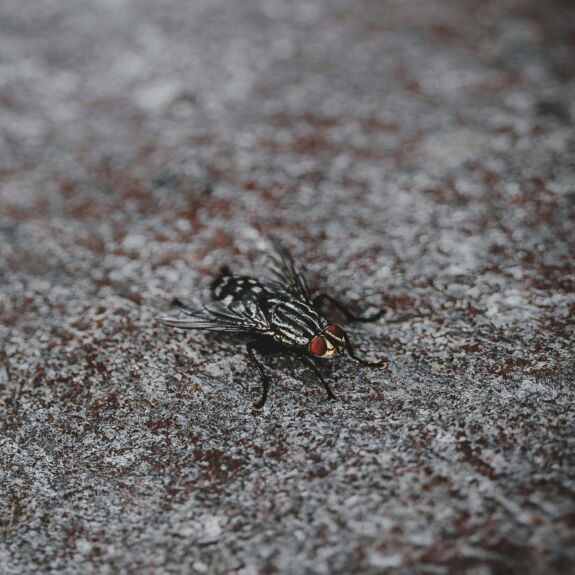
Houseflies are one of many nuisances that affect homes across Québec. But don’t worry, this guide will help you solve your infestation!
What is a housefly?
The housefly is the most common fly species. Houseflies are dark gray in color, with tiny golden hairs on their back, long wings, and measure about 8 mm in length.
Cluster flies are parasites of earthworms that develop in rich soil. They do not spread disease. They are generally considered a nuisance because they enter homes in autumn through cracks and crevices.
Houseflies lay their eggs in soil or in animal droppings. The larvae remain in the soil and hatch when the weather warms in spring. The larvae then burrow into earthworms and develop into adult houseflies. This life cycle usually lasts between 27 and 39 days.
How do I know if I have a housefly infestation?
Houseflies leave small dark droppings on walls or windows that can be difficult to clean. Another problem is that if they die in places like wall voids or false ceilings, they can attract other pests such as beetles, also known as stored-product insects.
What causes houseflies to enter homes?
Houseflies usually start to develop in spring and summer, and when autumn arrives these pests seek shelter indoors. In winter, they are generally only seen inside homes, where they wait out the cold. When houseflies gather in the less-used areas of your home, they form a swarm.
How can I prevent and control a housefly infestation?
There isn’t much you can do after autumn, so the best approach is to have a prevention strategy in place.
The following are natural pest control methods. Chemical pesticides pose health and safety concerns. If these natural prevention and control strategies do not work, contact an exterminator.
Vacuuming
Adult houseflies do not reproduce or lay eggs in your home, so if they cannot find a way out, they will simply die there. Many people use a vacuum to remove dead flies that entered through window and door frames. Unless you have a serious problem, this may be all you need.
Because they move slowly, it’s easy to vacuum or even sweep them up. They cluster on windows as they look for a way out. For hard-to-reach spots or small areas, you can use a handheld vacuum. Just be sure to empty it as soon as possible and empty it outside, rather than releasing the flies back indoors.
Wait for spring
If you think the infestation is small enough to be only a minor nuisance, you can simply wait for spring. Houseflies are more common in autumn and winter because they seek warmth and shelter when the weather turns cold. The main problem, however, is that they will likely return and this will not solve your problem long-term.
Remove food sources
Houseflies love decaying food, especially anything sweet. Make sure perishable foods are eaten or thrown out before they attract flies.
If you have pets, remove food and water from their bowls after they have finished for the night to keep flies from feeding. When disposing of waste, ensure that garbage bins are tightly closed.
Use sticky fly strips
Fly strips work well if you can place them somewhere out of sight. Many people dislike them because insects get stuck in full view, something you probably don’t want in your kitchen or dining area. That said, they are guaranteed to attract and kill houseflies.
Eliminate standing water
Because flies need surface water to survive, good drainage helps prevent them. Standing water or soft, soggy areas in your yard can contribute to a large insect problem.
Poor lawn drainage is an issue that should be addressed. Remember, though, that just because the infestation is indoors doesn’t mean the problem isn’t also outside. An unmaintained lawn is a perfect breeding ground for houseflies.
If you have a moisture problem in your basement, consider installing or replacing a sump pump and/or drainage pipes. Digging shallow trenches around the house and maintaining your lawn can also improve drainage. Check for blockages and other drainage problems.
Seal cracks and gaps
Seal your home carefully:
- Houseflies enter through the smallest cracks or gaps.
- Warm attics with plenty of hiding spots are particularly attractive.
- Houseflies love to linger in gaps between curtains.
- They emerge from wall voids and move toward windows when daytime temperatures rise in winter—this is when you’re most likely to see them.
Cracks can be sealed in several ways:
- A simple caulking gun and caulk (less than $5 a tube) will seal small spaces and fissures.
- Spray foam insulation can seal larger gaps.
- At night, use a flashlight to check for cracks where light shines through.
- If you’re alone, turn on a bright light in a room and inspect from outside to spot leaks.
- Mark problem areas with chalk and seal them the next day.
True prevention is only possible by keeping houseflies from entering your home.
Call an exterminator
If you have a large infestation, a professional exterminator can apply residual sprays to target active flies. Companies such as VEXT can help you implement effective pest control strategies and eliminate your infestation once and for all.
VEXT offers housefly control services to ensure your home, business, or farm remains free of flies. Regular inspections are the best way to make sure your property stays pest-free.
Frequently asked questions
Will houseflies eventually go away on their own?
Houseflies that entered your home in autumn to overwinter will stay hidden and only emerge on warm, sunny winter days to try to exit through your windows. They will eventually leave when temperatures rise, but they will never disappear completely if left unchecked.
Do houseflies return every year?
Several species of flies can be found in large numbers in homes during spring and autumn. When temperatures begin to drop in early fall, it’s common for houseflies to move inside seeking a warm place to overwinter. Attics or rooftops of homes and farm buildings are often used for this purpose.
These flies will hibernate until temperatures rise again in spring if undisturbed. It is not unusual for these flies to leave a scent that attracts houseflies year after year, encouraging them to lay ever more eggs.
Related articles
Carpenter Ants or Black Ants: How to Tell the Difference Inside Your Home
Ants in your home? Learn when they’re just a minor nuisance and when professional intervention is essential to protect your house from serious damage.
What Do Insects Do in the Winter?
Discover how mosquitoes, bees, butterflies, and other pests survive the cold and how to keep them from entering your home.